In short
- Guest messages from Airbnb and Booking.com across 9 apartments are answered by Claude, which is started by a script without AI that looks in the database for an unanswered message every 4 seconds.
- From 20 to 28 November 2026 there were 946 runs, and 795 of them, or 84%, ended within 20 seconds because there was nothing to handle.
- The AI may tell a guest only a fact it has read in the database, and it sends everything else to the owner as a question.
- Every rule in the brief has a date and the case it came from, and most of this study is about those failures.
AI replies to guests work like this for me: a script without AI finds a new message, Claude loads the procedure, the whole thread and the facts from the database, and replies in the guest's language in the platform chat. When it has no verified answer, it asks the owner and promises the guest nothing on the matter for now. Data is from the server as of 29 November 2026.
Starting point: guests write whenever it suits them
Short-term rental has one unpleasant trait: questions arrive at any hour and in whatever language the guest chooses. In the 30 days from 30 October to 28 November 2026, 462 guest messages across 79 bookings came into the system, for 9 apartments. Arrival is self-service and possible any time from 3:00 PM, including after midnight, so a question about getting into the apartment can come at night too.
The first requirement is written right in the code from 27 August 2026 and says that reactions must be immediate. The second stands in the routine's brief in capital letters: make nothing up, because a written message in the platform chat can be used as evidence in a dispute. The table of failures below shows that this second requirement is not excessive.
The overall structure of the server is described in the previous study Claude Code in practice. This one goes deep into a single process, guest messages.
How the process is wired
A message from the platform arrives through an API connection in the rental management system, within about a minute according to the routine's brief. From that moment two layers work. The first is a small script without AI that asks the database every 4 seconds whether there is a guest message without a reply, and every 20 seconds checks whether the owner has answered any open question. Until it finds something, the model is not started on its account at all.
The second layer is the routine with Claude Code itself. It is started by that script as soon as it finds work and, independently of it, by a timer every 15 minutes that serves as a safeguard. A lock ensures that two copies never run at once.
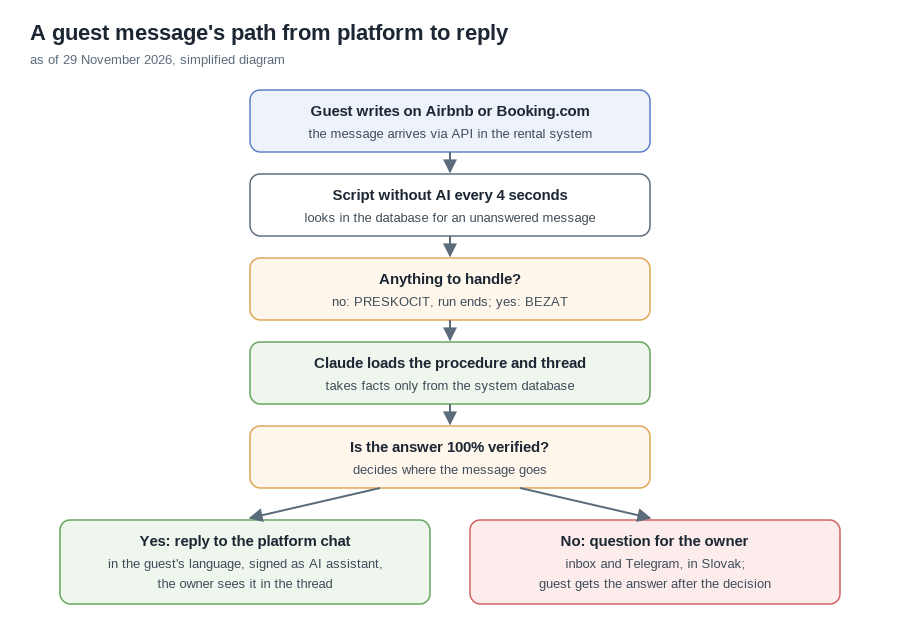
Every run starts with a single command whose first line of output is either PRESKOCIT (skip) or BEZAT (run). For the first result, Claude's brief says to stop immediately and read no further files. Only for the second does it load the detailed procedure, which is 39 kB, while the brief itself is 14 kB. So the script, not the model, decides whether there is anything to do.
There are more reasons for BEZAT than just a new message. The script also prints it when today's arrival still has an unfinished online check-in after 4:00 PM, when the owner has answered a question, when between 8:00 AM and 9:00 PM a guest needs a reminder about an unpaid add-on service, or when a guest has meanwhile completed check-in and an open question about them may no longer apply.
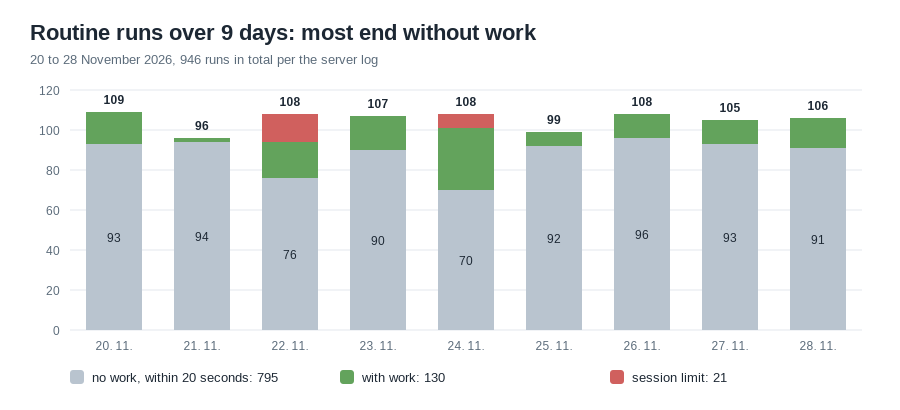
The server log for 9 days shows what this looks like in numbers. Of 946 runs, 795 ended within 20 seconds without work, with a median of 8 seconds. 130 runs had work, taking a median of about 2 minutes and 15 seconds, and the longest of them just under 28 minutes. The remaining 21 runs hit the session limit on 22 and 24 November and ended with an error, about which the launcher sends an alert.
What it looks like in the interface
The owner does not have to read logs, because everything is visible on two screens of the system. The first is Messages, where every booking has its own thread and where the reply the AI sent to the platform chat also comes back.
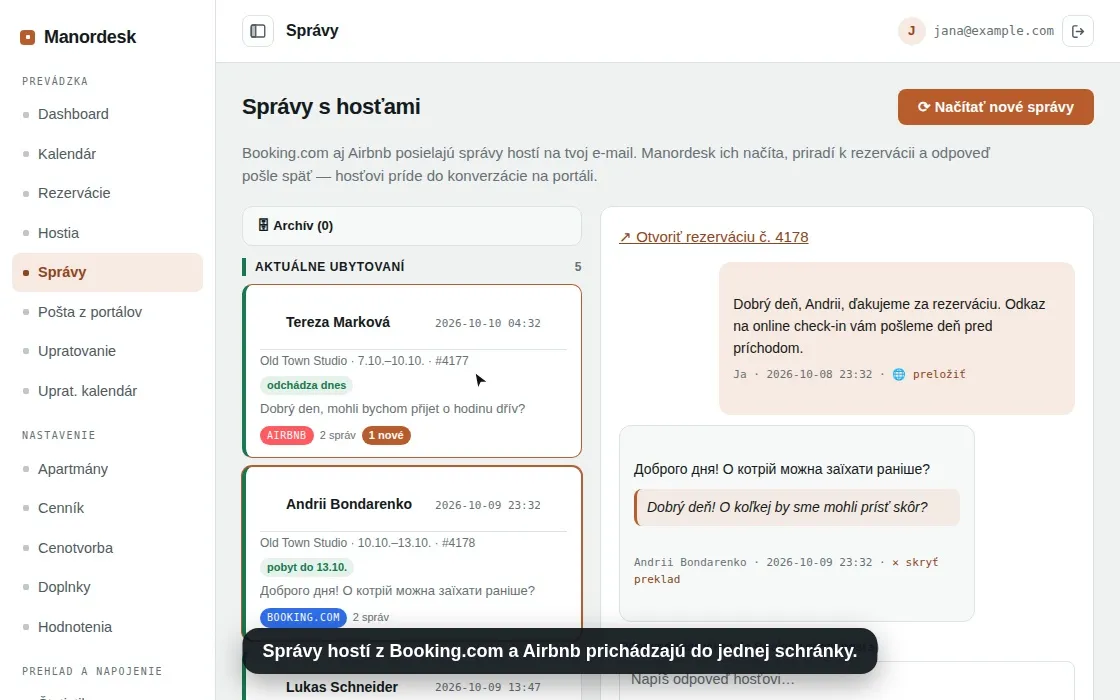
On the left of the screenshot is a list of threads with the guest's name, apartment, dates and platform label. On the right is an open conversation in which a Slovak translation is shown below the guest's message in Ukrainian (fictional data). The guest is answered in their own language, while everything goes to the owner in Slovak.
The second screen is the inbox. Everything the AI may not decide on its own ends up there, and the owner replies right in the field below the question or by replying to the message in Telegram.
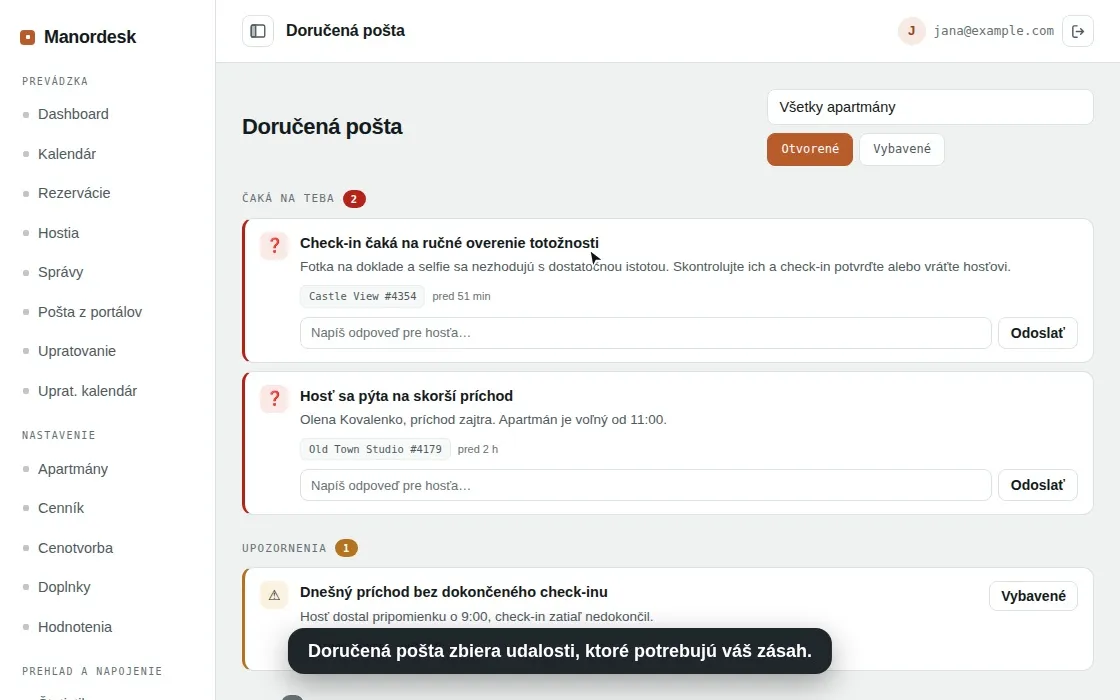
In this screenshot the “Waiting for you” section holds two cards, one about a manual identity check and the other about an earlier arrival, and below them one alert about today's arrival without a completed check-in (fictional data). In those 30 days, 71 such questions for the owner were filed and all of them are closed. For comparison, besides 456 automatic messages, another 374 went out to guests in the same period, which includes AI replies and the owner's manual replies together.
What failed and which safeguard was added
The routine's brief was not written at a desk. Almost every rule in it has a date and a description of the case where something went wrong, and the table shows those that offer a lesson outside rentals too.
| Date | What happened | Safeguard |
|---|---|---|
| 26. 7. 2026 | A guest received instructions on where to pick up the keys although their check-in was not complete. They got into the apartment without registering, and a refund request followed. | Before check-in is complete, the AI may only lead the guest to completing it, with no access instructions. |
| 27. 7. 2026 | A complaint got the reply that the problem was on our side, although nobody had seen the apartment. The guest later quoted it as evidence against the company. | A ban on admitting fault, confirming a guest's claim as fact and promising compensation or a repair date. |
| 29. 7. 2026 | A guest received a made-up position that an exception was not possible and gave a 2-hour ultimatum. The owner then decided the opposite. | The AI claims nothing about an exception until the owner confirms it, and files a question right away. |
| 29. 7. 2026 | The guest was told “we will check and confirm”, but no question for the owner was created. | After every promise to check, a question must be created in the same run. |
| 27. 8. 2026 | The owner opened the thread on a laptop, the message was marked as read and stayed 2 hours without a reply. | An unanswered message is no longer determined by read status but by a marker of the last handled message. |
| 27. 8. 2026 | While the reply was being written, 3 more questions arrived and were marked as handled. | On sending, the number of the last message the AI actually read is stated. |
| 30. 8. 2026 | A new question for the owner merged with an older card of the same booking and the alert was not sent. | Cards are also distinguished by title, and the AI must check that the question was really created. |
| 14 to 20 September 2026 | An automatic evening message counted as a reply, so the guest's question sat for 6 days. | Automatic messages are not considered a reply. |
| 20. 9. 2026 | 10 cards were created for one guest in one evening and stayed open after they had moved in. | One guest is one message in Telegram, new facts are added to the open card and handled cards are closed. |
| 14. 10. 2026 | When a guest sent two messages and got a reply to only one, the other was hidden. Three questions were lost this way and one sat for 19 hours. | The marker of the last read message is the single source of truth. |
| 28. 11. 2026 | The hosting rejected script calls with a 429 error, so the AI did not see the owner's answers to open questions. | The scripts identify themselves to the hosting with their own label, and the trap is described in their documentation. |
The table shows two kinds of errors. The first four rows are errors by the model, which wrote something it had not verified or did not follow through on its own promise, and they are treated with a rule in the brief. The rest are errors in the pipeline, where a message or question silently disappeared, and those cannot be fixed with an instruction, the script has to be rewritten.
Since 15 November 2026 there is one more loop. When the owner adds a note to a report, the AI writes down a lesson from it without guest names, and the script prints it in every later run with work. A newer lesson takes precedence over an older one.
What stays with a human
The limits are listed in the procedure and the AI does not cross them without the owner's consent. It may not grant a guest access until check-in is complete, may not change prices, bookings or settings, and may not issue invoices by hand. It never writes the key box code in the chat, the guest sees it only on their own link, 15 minutes before the arrival time.
A question for the owner has its own rules too, so that it can be read on a phone. The title has 3 to 6 words, the question is in the first sentence, the guest's text is translated into Slovak and the guest's name is not written in it. Telegram shows at most 180 characters of it, the rest is in the inbox.
Urgent alerts go out from 7:00 AM to 10:00 PM and others from 8:00 AM to 9:00 PM, so outside those hours a question waits open. Reminders go out on their own after 20 minutes, after an hour and after 3 hours, then every 12 hours. Alongside this, a separate watchdog runs every 10 minutes and checks whether guests really received the automatic messages.
There is also a list of guests the AI does not write to at all, because the owner handles communication with them differently. The sending script rejects such a message, and if the list were damaged, nothing would go out to anyone, to be safe.
How another company can use this
The approach can be carried over to any company that answers customers by chat or email, such as an online store, a repair service or a medical practice. If you are considering a similar setup, you will find the wider framework on the AI process automation page and related topics in the AI in business section (in Slovak).
- Give the “is there anything to do” decision to a script, not the model, and start the model only when there is work.
- Split the brief into a short part that is always read and a long procedure that is read only when there is work.
- Define a single source of facts from which the AI may answer, and send everything outside it to a human.
- List what the AI must never do: admit fault, promise an exception, a discount, a date or a refund.
- Build one place where questions wait for a human, and verify that the question was really created.
- For every rule, note the date and the case it came from, so that nobody deletes it as unnecessary six months later.
A brief you can start from looks like this once generalized:
You are a customer support assistant for the company [name]. Write to the customer
in their language, to me in English.

1. Always start with the command [script], which prints PRESKOCIT or BEZAT.
2. On PRESKOCIT write one sentence with the reason and stop. Read nothing else.
3. On BEZAT first read the whole procedure in the file [path]. Without it
   you will not write a single word to the customer.

Always applies:
- Every fact must come from [database or table]. If the data is not there,
  do not answer with a guess, ask me and write nothing on it to the customer yet.
- Do not admit fault for the company, do not promise compensation, a discount,
  an exception or a date.
- If you wrote “I will check” or “I will get back to you” to the customer,
  a question for me must be created in the same run. Check the script output
  to see that it was really created.
- Before replying, read the whole thread, not just the last message.
- Put a signature under every message that makes clear an AI assistant is writing.
- Do not file a second question on the same matter, add new facts to the open one.
Most of the work is not in this text but in the script that reliably determines which message still has no reply. In my case this very part was modified four times, as shown by the table rows from 27 August, 20 September and 14 October 2026.
Frequently asked questions
Does the guest know an AI is replying?
Yes, every message ends with a signature in the guest's language, in English “Clary, your AI accommodation assistant”. The signature is mandatory under every reply, even in a quick exchange of several messages in a row.
What happens when the AI does not know the answer?
It files a question for the owner in the inbox, from which an alert goes to Telegram, and it claims nothing about the matter to the guest until the owner replies. Then it writes to the guest only what the owner decided. In the 30 days to 28 November 2026, 71 such questions were filed.
How fast does the reply come?
The script looks for a new message every 4 seconds and starts the routine as soon as it finds one. From 20 to 28 November 2026 a run with work took a median of about 2 minutes and 15 seconds, and one run may handle several things at once. When the session limit is used up, the message waits for the next run.
Can the AI promise a discount or a refund?
No, compensation, a discount, a refund and a repair date are explicitly forbidden in the procedure. For a cancellation it refers the guest to the booking terms on the platform, because the host does not decide on them. A request beyond those terms goes to the owner as a question.
Does the AI also reply to guests who booked directly on the website?
Yes, since 12 September 2026 the sending script emails the same text to such a guest, because there is no platform chat, and records the message in the thread in the system. For a platform booking, email is not used, since the guest would not see it in the platform's app.